Almost every software company is now selling an AI agent that will supposedly run your business while you sleep. Book meetings, reply to customers, chase invoices, keep the socials going. The demos look great. I build with these agents most weeks, and what the demos never show you is how often they fall over, and how predictable it gets once you have watched it happen a few times. They tend to fail in three ways.
This is a worse problem for a small business than a large one. A large company can put a person on top of the agent to check its work and fix what it breaks. If you are running a small business, you heard "autonomous" and assumed it meant you could stop watching, because that was the whole point. The distance between what "autonomous" promises and how much babysitting these things actually need is where your time and money quietly go.
What an agent is actually doing
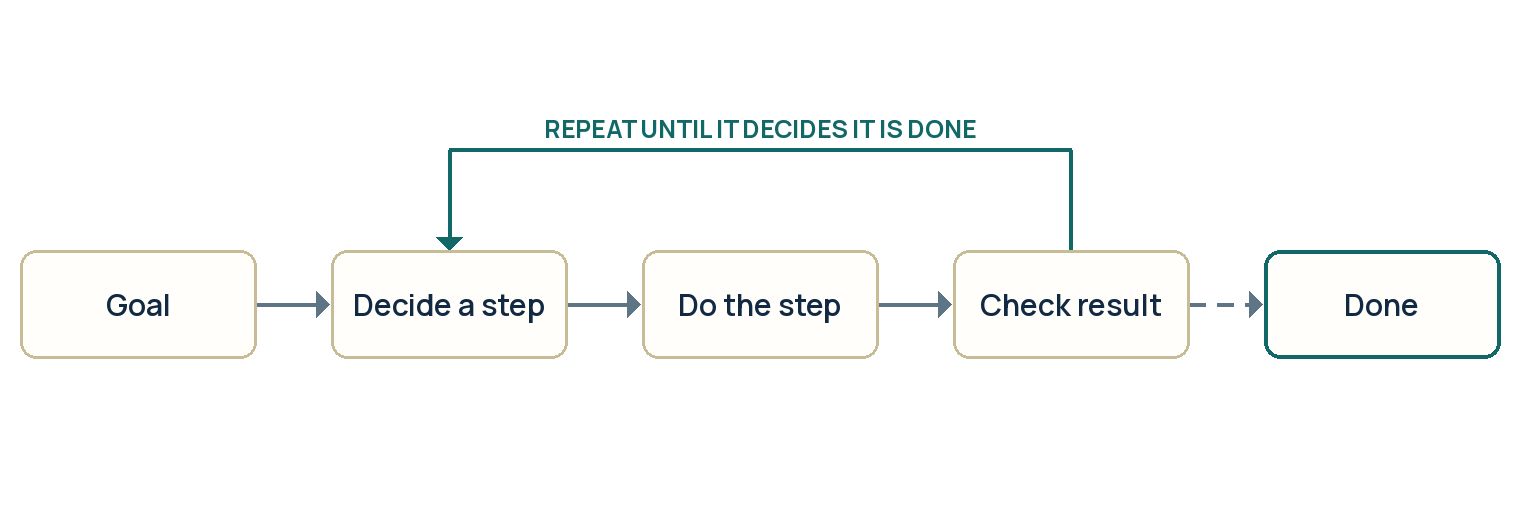
Underneath the marketing, an agent is a loop. It takes a goal, picks a step, does the step, checks what happened, and picks the next step, over and over until it decides it is finished. Useful, but fragile, because every step stands on the one before it. If it gets an early step a little wrong, it does not notice. It just carries on.
Break one: small errors pile up and the agent cannot feel it
When you are doing a ten-step job yourself and step three feels off, you stop and check. The agent has no such reflex by default. Unless one is built to check its own work, it treats its last answer as fact, so a small mistake at step three gets baked into everything after it, and what comes back to you is neat, confident and wrong, with nothing flagging it. This gets worse the longer the job runs. An agent can look flawless in a three-step demo and fall apart on a fifteen-step process, and most real work is closer to fifteen steps than three.
Break two: the boring plumbing, not the thinking
The thinking is the cheap part now. Everything around the thinking is where it struggles. The tool that quietly moved a button since last month. The customer who replies in a way nobody scripted for. The payment that only half goes through. The wrong file format. The login that wants a code off your phone. Demos happen in clean little sandboxes where none of that exists, and your business is not a clean little sandbox. When I see one of these agents fail, it is usually not because the model was stupid. It ran into some ordinary real-world mess nobody set it up to handle, and it either froze or made something up.
Break three: judgment on the things you never spelled out
Every real job comes with rules nobody ever wrote down. Do not email this client in the evening. Pay that supplier before the others. Anything over a certain amount, check with me first. A new employee soaks these up over a few months. An agent only knows what you actually told it, and you will never tell it all of this, because it is obvious to you and it never occurs to you to say it out loud until the day it goes wrong. Left alone, it follows the instructions literally and fast, and every so often it does something you would have stopped in a second if anyone had thought to ask you.
So where are they actually worth using
All three failures come from the same root. Agents struggle when a job is long, when it is plugged into messy real systems, or when it leans on judgment you never spelled out. So the work worth handing over is the opposite of that. Give an agent something that is:
- short, not a long chain of steps that each depend on the last
- easy to undo, so a mistake costs you a redo and not a client
- spelled out in full, with nothing important left sitting in your head
- checked by you before it does anything involving money or a person
A first draft of an email you will read before it goes out. A summary of a long document. Cleaning up and tagging a messy inbox. Rough first-pass research you are going to verify anyway. That kind of thing will save you hours. "Handle all my customer support on its own" will not, at least not yet.
The bottleneck was never the model
Here is the part people miss: a cleverer model helps with some of this, but it does not make it disappear. A smarter agent makes fewer mistakes per step, but it still trips over the same dull plumbing and still does not know the rules you never told it. The hardest limits were never really about how clever the model is. They are in the messy join between the agent and the real world it is meant to work in, and in knowing which jobs should never be handed off at all. That is the unglamorous part, and it is the part hardly anyone is selling you. The day someone shows you an agent that deals with the boring plumbing and knows when to stop and check with you, that is the one worth paying for.
So if someone tries to sell you an agent this year, ask them one thing: show me where it stops and asks a human. If it never does, that is not autonomy. It is just risk with a nicer interface.